90 % of companies outside CSRD plan to continue sustainable reporting.
The company osapiens, in collaboration with Professor Andreas Rasche from Copenhagen Business School, approached more than 400 senior executives (CSO, CFO, CIO, heads of compliance and supply chain) from European companies with more than 1,000 employees.
90 % of companies that were exempted from CSRD obligations under Omnibus I plan to maintain or even expand their activities in sustainable reporting.
86 % of them state that they are able to continue producing reports at the level of CSRD standards.
90 % of respondents state that sustainable data are already partially or fully integrated into financial reporting.
Companies use sustainability data, for example, for: operational planning (53 %), innovation and process design (48 %), financial planning (38 %), supply chain risk assessment (38 %).
Companies describe the benefits of reporting mainly in: better insight into climate and operational risks (49 %), stronger investor confidence and ability to respond to ESG inquiries (44 %), meeting customer and partner requirements (44 %), better linkage of financial and sustainability decision‑making (43 %).
90 % of respondents expect an increase in investment in tools and automation for sustainable reporting over the next 12 months. On the other hand, 84 % acknowledge that reduced regulatory pressure will over time lead to fewer internal resources devoted to reporting.
The biggest challenges include: costs of data collection and analysis (43 %), fragmented data across systems (40 %), poor technology integration (31 %), and unclear ownership of reporting responsibility (29 %).
Related articles
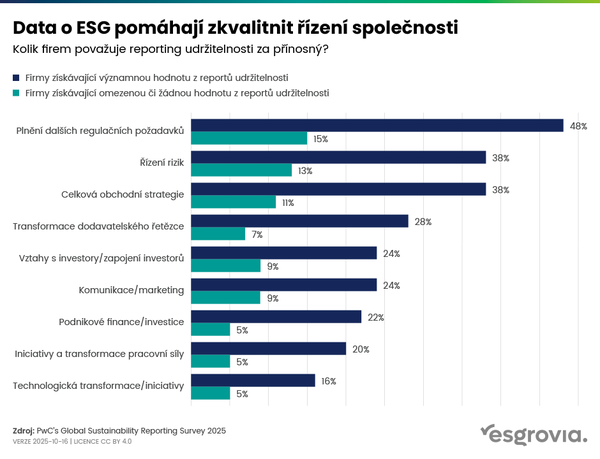
Data on ESG help improve company management