Data on ESG help improve company management
Companies that monitor, and possibly also report, their sustainability data see significant value in this data for formulating their business strategy and managing the firm. This is confirmed by the results of the current global survey by PwC, as well as by our experience at esgrovie. Based on honest data collection, companies can simply make better decisions.
PwC's sustainability reporting survey, which included 496 companies from 40 countries, shows that pressure for transparency in ESG (environmental, social and governance) continues to increase. Approximately 36% of respondents have already reported according to CSRD or ISSB, with more than two‑thirds of them stating that the data they gathered during reporting provided them with significant or moderately significant value beyond merely meeting regulatory requirements. For example, 38% of these companies use ESG data for strategic planning, risk management, while 20‑25% of respondents use reporting information to transform the supply chain, corporate finance and investments, or to transform the workforce.
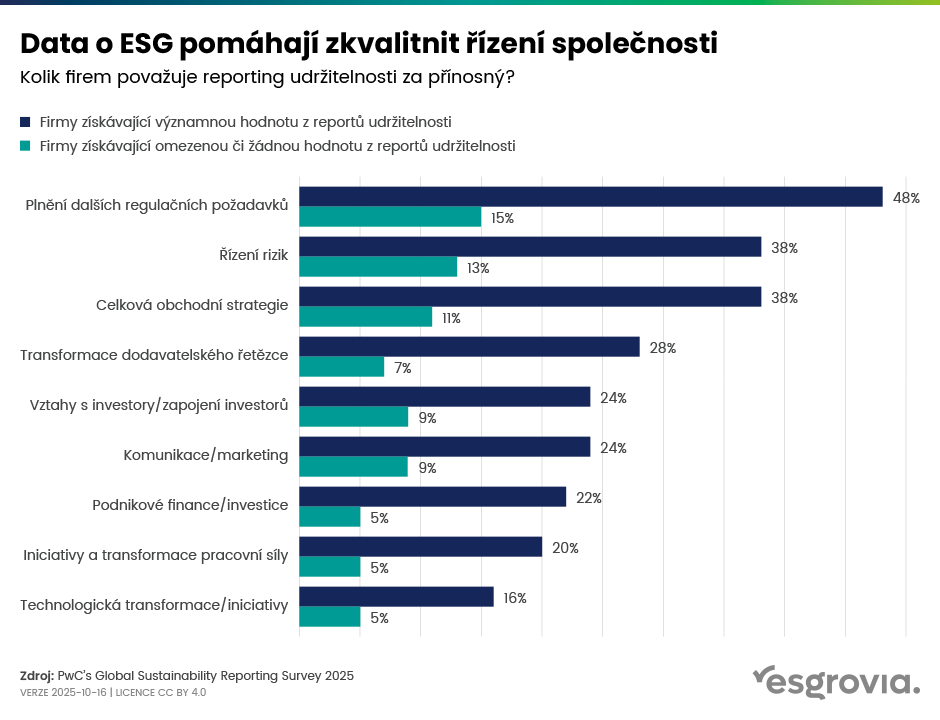
Companies that have extracted the most from ESG reporting are characterized by a higher level of technological sophistication and stronger involvement of top management. Interest from top leadership is therefore key for sustainability data to play a positive role in company management.
A significant shift has also occurred in the technology area – the use of artificial intelligence in ESG reporting has risen from 11% to 28%. AI is most commonly used for summarizing statements, identifying risks, and integrating data from various sources, which enables companies to manage reporting data more efficiently. The respondents' answers also highlight how important it is to manage data properly. The key to successful reporting is creating a central repository of sustainability data; companies also use tools for carbon footprint calculation, ERP systems, or tools for managing information disclosure.
The survey was conducted by PwC in June and July 2025 on a sample of 496 senior executives and senior specialists in 40 countries (66% of them in Europe) at companies that have submitted or will submit sustainability reports according to CSRD or ISSB.
You can find more interesting survey results here.
Source: PwC, 2025.
The change in ESG reporting rules under CSRD has undoubtedly slowed the original positive trend of ESG reporting preparations; the survey indicates that 40% of companies originally planning to report under CSRD will take advantage of a two‑year postponement, while the same proportion intends to continue according to the original schedule. In addition to pressure from other stakeholders such as banks, investors, etc., a large number of companies are also driven by the belief that sustainability data and insights constitute a competitive advantage not only due to better preparedness for regulations but also because of higher‑quality decision‑making throughout the enterprise.
Related articles
Abundant cheap energy as a determining factor of business sustainability