Carbon footprint
Most companies will sooner or later have to calculate and disclose their environmental impact in the form of determining their carbon footprint. This will automatically be required by banks when applying for a loan.
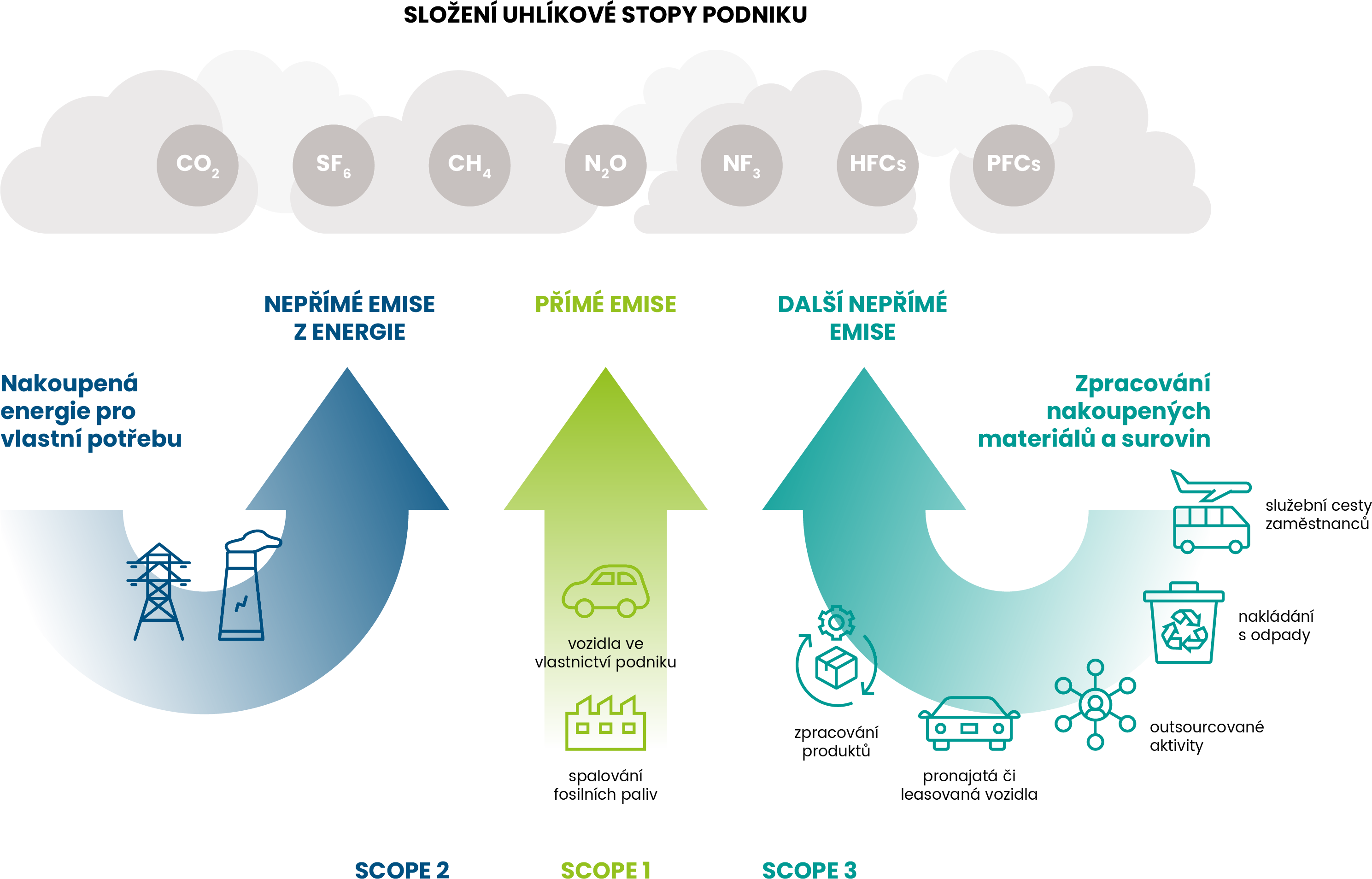
The calculation of the carbon footprint is defined by European legislation (based on the GHG Protocol Corporate Standard corresponding to ISO 14064 standards at the organizational level, ISO 14067 at the product level), which divides emissions into three basic categories: Scope 1, 2 and 3. A company must calculate the CO₂ emissions produced by its activities, both directly within its own operations (Scope 1) and indirect emissions (Scope 2‑3) arising, for example, from purchasing energy or materials from suppliers.
If you supply your products and services to medium and large companies or export, you will sooner or later be asked to calculate your carbon footprint for the needs of your customers. This means that, within your buyer‑supplier relationships, you will have to calculate your carbon footprint earlier than the current legislation applicable to a company of your size requires.
Calculate your carbon footprint
Our web carbon‑footprint calculator allows you to easily and quickly calculate your company's CO₂ emissions. Just enter data on energy consumption, transport or waste and you will immediately get clear results. The calculation follows verified methodologies and the resulting data can be easily transferred to our professional application, where it can be further analyzed, monitored over time, and used to generate detailed reports.
You will receive the results immediately.
Calculate carbon footprint
Application esgrovia
Our application makes it easier to manage data on the impacts of your business on the environment and society. It enables the calculation of a carbon footprint for companies and products, the creation of certificates, and interactive sustainability self-assessment.
It supports the collection of data points across flights, document uploading, and easy import and export of data. This provides you with clear documentation for responsible decision-making and long-term planning.
More information
You might be interested in...
What does climate change mean?
According to the UN Framework Convention on Climate Change, climate change is a 'change of climate which is attributed directly or indirectly to human activity that alters the composition of the global atmosphere and which is in addition to natural climate variability observed over comparable time periods.' One of the accompanying phenomena of climate change is the increasing concentration of carbon dioxide in the air and rising average temperatures, caused by increased production of greenhouse gases. Therefore, in December 2015 at the UN Climate Summit in Paris, governments of 174 countries committed under the Paris Agreement to keep global warming at the limit of +2 °C by mid-century compared to pre-industrial times – ideally at 1.5 °C. Among other things, this goal means that states and businesses will reduce their dependence on fossil fuels as a primary energy source.
What are greenhouse gases?
Greenhouse gases (GHG) are gases present in the Earth's atmosphere that contribute to the greenhouse effect. They can be of natural origin (such as water vapor, methane) or produced by human activity (e.g., burning fossil fuels). When evaluating human impact on the environment and climate change, human-produced greenhouse gases are our primary focus.
What are the main greenhouse gases?
The GHG Protocol distinguishes seven anthropogenic greenhouse gases that are essential for calculating a company's carbon footprint. The most common is carbon dioxide (CO2). Other greenhouse gases include methane (CH4), nitrous oxide (N2O), nitrogen trifluoride (NF3), hydrofluorocarbons (HFCs), perfluorocarbons (PFCs), and sulfur hexafluoride (SF6). Within a carbon footprint calculation, other greenhouse gases can be converted to carbon dioxide, which acts as an 'umbrella' for all GHG. Using the 'Global Warming Potential (GWP)' indicator, the so-called 'CO2 equivalent' can be determined.
What is Global Warming Potential (GWP)?
Global Warming Potential (GWP) allows for the comparison of the impacts of different gases on global warming. The indicator compares how much energy the emission of 1 ton of a gas will absorb over a given period relative to the emission of 1 ton of carbon dioxide. This allows for the determination of the 'CO2 equivalent' (stated as CO2 ekv., CO2 eq., or CO2e). A period of 100 years is typically used. The higher the GWP, the more the gas warms the planet compared to CO2 over that period.
What is the GHG Protocol?
The GHG Protocol sets the standards for measuring and managing greenhouse gas (GHG) emissions for both private and public sector organizations. The GHG Protocol is supported by a partnership between the World Resources Institute (WRI) and the World Business Council for Sustainable Development (WBCSD), along with cooperation from other public and private entities. The GHG Protocol standardizes the measurement, management, and reporting of greenhouse gas emissions and is also followed by European legislation.
Which standards determine carbon footprint calculation?
In addition to the GHG Protocol, ISO standards are also used in Europe for calculating greenhouse gases and carbon footprints. The ISO 14064 standard consists of three mutually complementary components. ISO 14064-1 includes requirements for planning, implementation, management, reporting, and verification of greenhouse gas emission inventories for organizations. The second part (14064-2) regulates requirements for monitoring and reporting achieved emission reductions or increased greenhouse gas removals through projects and/or project-oriented activities. The third part (14064-3) establishes principles and requirements for verifying greenhouse gas inventories and for validating and verifying greenhouse gas projects. The GHG Protocol and ISO 14064 are mutually consistent.
What are emission factors?
Emission factors express the relationship between the amount of a pollutant released into the atmosphere and the activity associated with its release. These factors are usually expressed as the mass of the pollutant in CO2 equivalent divided by a reference unit, which can be product weight, volume, distance, or duration of the activity emitting the pollutant. Emission factors are part of the carbon footprint calculation, and some can be country-specific, defined by national methodology.
What is a Corporate Carbon Footprint?
The Corporate Carbon Footprint represents the impact of an organization's operations on the environment and, primarily, its influence on climate change. It includes the total amount of greenhouse gas emissions produced during all company activities. It serves as an indirect indicator of the consumption of energy, materials, services, etc., not only within its own operations but also within supply chains. By calculating their carbon footprint, companies (and other organizations, e.g., in the public sector) can analyze the impact of their operations on climate change and identify opportunities to improve their environmental impact.
What is a Product Carbon Footprint?
The Product Carbon Footprint evaluates greenhouse gas emissions generated throughout the entire life cycle of a product, from raw material extraction to waste disposal. The calculation of a product's carbon footprint is linked to Life-Cycle Assessment (LCA) data related to greenhouse gases.
Why should we calculate our carbon footprint?
Carbon footprint calculation is driven by European legislation and will be mandatory for most companies within a few years. If you supply products and services to medium and large companies or export, sooner or later you will be asked to calculate your carbon footprint for their needs. Similarly, a bank may require it if you apply for a loan. This means you may need to calculate your carbon footprint sooner than current legislation requires.
Which standards determine carbon footprint calculation?
ISO standards governing the calculation of greenhouse gases and carbon footprints are consistent with the GHG Protocol. The ČSN ISO 14064 standard – Greenhouse Gases is focused on determining an organization's carbon footprint and consists of three parts. Part one (ISO 14064-1) defines principles and requirements for determining, reporting, and verifying greenhouse gas emissions in an organization. Part two (ISO 14064-2) focuses on determining and reporting emission reductions achieved through projects or project-oriented activities. Part three (ISO 14064-3) relates to principles and requirements for conducting validation and verification of greenhouse gases for the purpose of determining, monitoring, and reporting an organization's or project's greenhouse gases. The ČSN ISO 14067 standard – Greenhouse Gases is focused on determining a product's carbon footprint, in accordance with international standards for Life Cycle Assessment (LCA). The standard relates the calculation to climate change (i.e., it does not evaluate social or economic consequences or other environmental impacts arising within the product's life cycle).
In what units is the carbon footprint calculated?
A corporate carbon footprint is usually expressed in tonnes of carbon dioxide equivalent (t CO2e). For specific activities or a product carbon footprint, kilograms (kg) or grams (g) of CO2e can be used. However, inputs for the calculation can be diverse, such as kWh or MWh for energy, tonnes or kilograms for weight, etc.
What is carbon neutrality?
Carbon neutrality means achieving a zero carbon footprint, i.e., net-zero emissions. Given the complexity of this goal, it is crucial that the primary interest of every emitter is to reduce the amount of pollutants emitted.
What are carbon offsets?
Offsets, or carbon compensations, represent another way to reduce emissions and achieve carbon neutrality. Emissions created in one sector or by one emitter can be compensated for by reductions in another sector or by another emitter. Offsets are calculated relative to a baseline value representing a hypothetical scenario for the original state—the emission level if the offset project (e.g., investment in renewable energy sources, energy efficiency improvements, etc.) were not implemented. An example of a European carbon compensation system is the Emissions Trading System (ETS).